Route optimization is the automated planning of stops across vehicles or technicians so total driving and overtime are as low as possible while every constraint holds: service windows, shift hours, crew sizes, skills and breaks. For delivery it usually means ordering one day’s stops. For recurring field service it also means choosing the day each customer is served within the week, keeping usual days and technicians, and showing a person what it couldn’t place and why.
What route optimization solves
Under the hood, route optimization is a version of the vehicle routing problem: given customers, vehicles and rules, find routes that cost the least. Software tries many combinations quickly using drive-time data from a map provider. The output is a set of routes, each an ordered list of stops with arrival times.
The constraints that matter for service teams
| Constraint | Example |
|---|---|
| Service windows | Kitchen service 5:30–9:00 AM, before opening |
| No-go times | Not during lunch; not on event days |
| Shift hours and clock-out | Deploy by 5:30 AM, no new stops after 3 PM |
| Crew size and time on site | 90 minutes with two people, 65 with three |
| Usual day and technician | Same person, same day, unless there’s a reason |
| Skills and equipment | Certified for suppression systems; the van with the pressure washer |
| Time off and out-of-service equipment | A technician on leave; a truck in the shop Friday |
| Night routes | A 10:30 PM to 4:00 AM route is one shift, not two days |
Why recurring weekly routes are different from daily delivery
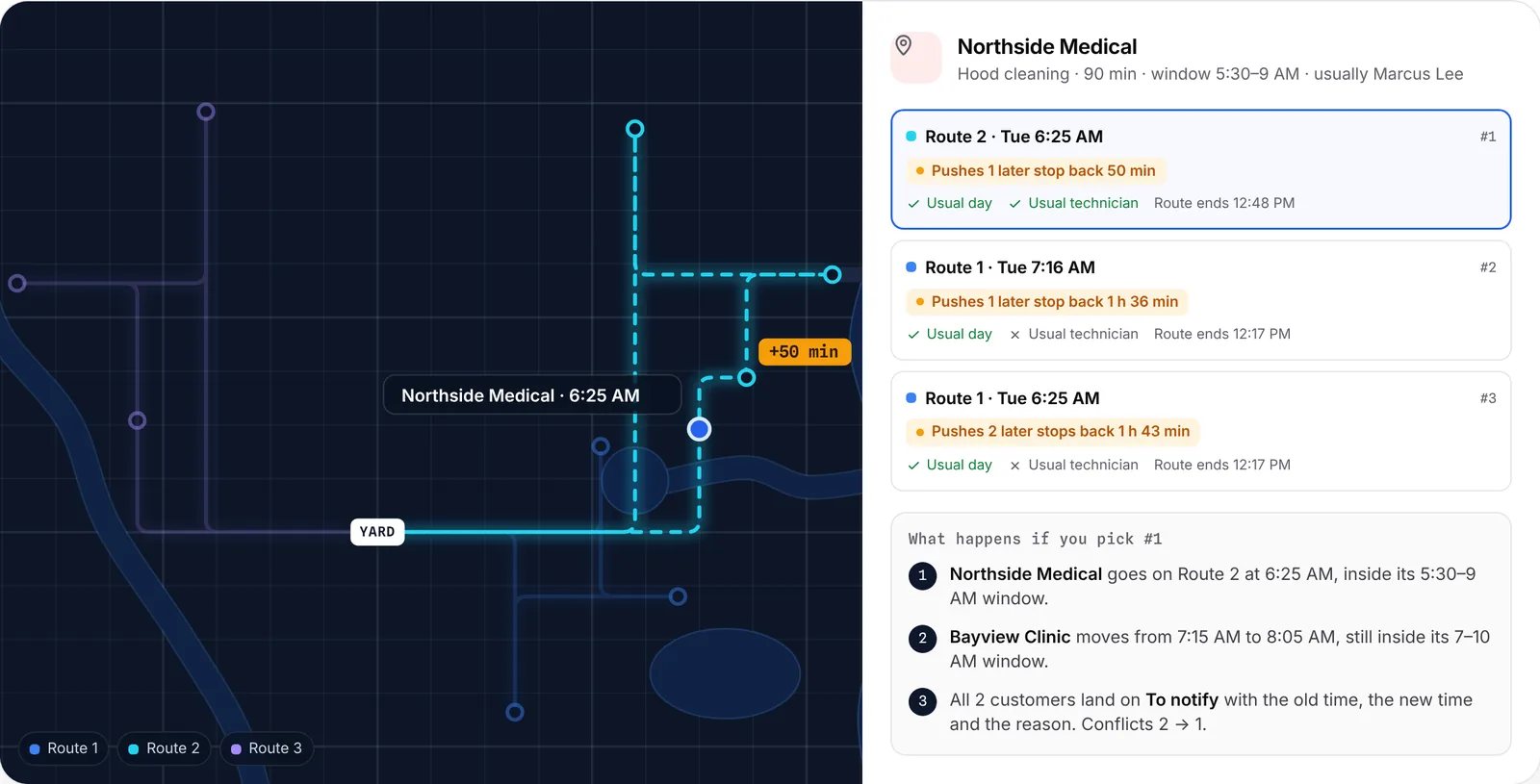
Delivery optimizers usually take one day’s orders and sequence them. Recurring service has an extra decision: which day. An every-other-week customer who can be served Tuesday or Wednesday, a monthly customer who must be served in the second week, and a quarterly job that needs three people all compete for the same week. Good recurring optimization:
- generates the week’s due visits from each customer’s cycle before routing them;
- chooses days within each customer’s allowed days, not only stop order;
- keeps usual days and technicians unless moving them saves real time;
- balances the week, so Monday isn’t overloaded while Friday is empty.
What good optimization looks like
- Honest about what it couldn’t do. Anything it can’t place is listed with the reason, not silently dropped or squeezed in late.
- Explainable. You can see why a stop is where it is and what moving it would push back or bump.
- Real drive times. Road network times, rounded up, not straight-line distance. Unknown addresses are flagged, not guessed.
- A person approves the plan. Optimization proposes; the scheduler decides, and every manual change is recorded with a reason.
Questions to ask a route optimization vendor
- Does it plan a whole week across all technicians, or one day (or one technician) at a time?
- Does it respect service windows while optimizing, or only for visits with no set time?
- Can a visit need two or three people, with a different time on site for each crew size?
- Does it generate recurring visits from customer cycles, or do I re-create them?
- What happens to stops it can’t place?
- Can I see what a manual move bumps before I make it, and is there a change log?
- Is optimization included, or an add-on, and how is it priced (per driver, per user, per vehicle, per order)?
Answers for specific tools are in our comparisons: OptimoRoute, Jobber, Route4Me, Dynamics 365 and more.
How Crewtide does it
Building the week in Crewtide places every due visit on a route using real drive times, service windows, shifts and crew sizes, then orders the stops to cut driving. It keeps usual days and technicians where it can, lists anything it couldn’t place with the reason, and lets you check and adjust before you publish. Route optimization is included on every plan, from $49 per technician a month billed annually.
Questions
What is route optimization?
Route optimization is software that plans which vehicle or technician visits which stops and in what order, so total driving and overtime are as low as possible while every rule (windows, shifts, crews, skills) still holds.
What is the difference between route planning and route optimization?
Route planning is the whole job of building routes, by hand or with software. Route optimization is the automated part that searches for the best set of routes under your constraints.
How much can route optimization save?
It depends on how the routes are built today. Teams that plan by hand often find hours of driving a week; the honest way to know is to rebuild a real week and compare. Our cost calculator shows what those hours are worth.
Does route optimization handle time windows?
Most field service optimizers do, but some only optimize visits without a set time. Ask whether windowed visits are optimized or just left in place.
Is route optimization included in Crewtide?
Yes, on every plan.